 Many people may feel nervous about new situations, especially when they involve matters closely connected to oneself, such as a doctor’s or therapy appointment. In this text I will open up a little about what typically happens in an expressive arts therapy group in the hope that this might lower the threshold for participation at least to some extent.
This is not a literal step-by-step description, as every expressive arts therapy group is unique, and I use different assignments with different groups and at different times. I will write more on the interactional possibilities that a group offers on another occasion. Here I focus especially on the structure of the very first group meeting. I hope this text provides helpful information for someone who has never encountered this kind of work before. It is also important to remember that every therapist or facilitator works in their own way: others may have different practices. In this article, I am speaking solely from my own way of working.
Forming the Group
 A group can be formed in many different ways. In recent years, I have mainly facilitated online groups and kept registration open to anyone interested. Somehow – quite magically – the people who join my groups usually share meaningful similarities in their life situations. The groups become very enriching as participants also gain insights from each other’s work and perspectives. These people are usually subscribers to my newsletter or have found me through social media.
I see the same phenomenon in adult education centre courses as well, where many participants have not heard of me beforehand.
A group can also be formed around a shared factor; for example one of my colleagues has facilitated art therapy retreats for a breast cancer association. Groups can also be created for people of a specific age.
Personally, I have found it very rewarding when groups include people of widely different ages. Someone approaching retirement may gain fresh perspectives from someone who has only recently reached adulthood, and vice versa. The feedback I receive reflects this as well.
Beginning the Session
 As a rule, I aim to begin each group meeting in the same way.
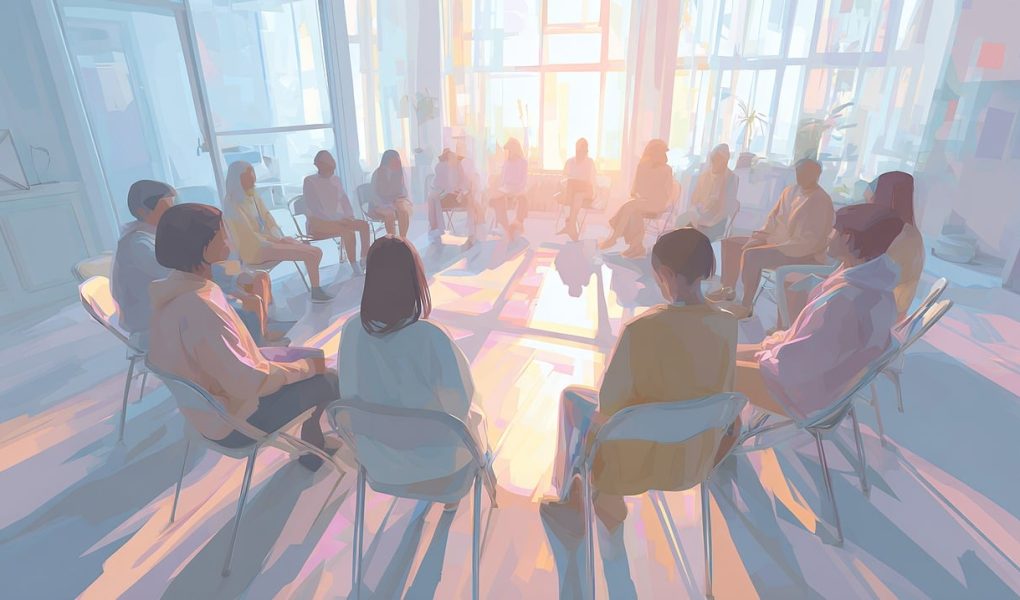
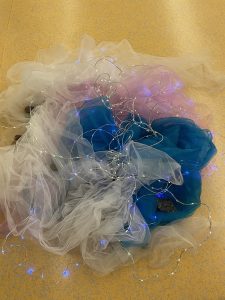
If I am facilitating a live course where participants are physically present in the same space, I usually arrange the chairs in a circle—though it is almost always possible, and often preferred, to sit on the floor. In the centre of the circle, I create a kind of arrangement using various objects and items.
I may include some items that gently directs thoughts toward the upcoming work. For example, in a session focused on character work, I might use postcards featuring people in masquerade costumes. Or I may have found branches or leaves outdoors that I want to bring into the space for the group’s enjoyment. Sometimes I bring a potted plant or cut flowers.
Many participants have commented that it feels like sitting around a campfire—especially because I like to include candles in the arrangement. If real candles are not possible, I use LED candles or other battery-powered lights as part of the setup.
Campfire circles have a long, long tradition in human history, and various forms of circle-based work are still widely used today. In a circle, each participant has their own place, equally distant from the centre.
At the beginning of each session, we usually sit in a circle. Each participant has the opportunity to share who they are and what kind of mood they are arriving with.
As the group becomes more established, I may also introduce different kinds of openings. For example, I might invite participants to walk around and allow themselves to find an experience that has especially touched them between sessions. After this, we return to the circle and do an opening round. This helps everyone “find their place” in the group, even though nothing has to be shared or spoken aloud.
In online groups, this opening circle can be formed as a guided imagery exercise.
During the first meeting (and later if needed), we go through the basic principles of working together—for example, that artworks are not evaluated, that everyone speaks only from their own perspective, and that each creator makes their own interpretations of their work.
Attuning to the Work
 After the opening circle, it is time for the working phase.
Usually, we begin by attuning ourselves. Very often, I use bodily attunement. I might, for example, invite participants to become aware of the flow of their breath. Quite often, I guide attention to the fingers, sensing how they move and what kind of movement feels good and necessary for them. It is often helpful to scan through almost the entire body in this way, bringing attention to it.
This helps participants enter a state of presence and observation. Especially when the group meets on a weekday and people arrive straight from their everyday lives, focusing on the body and being present in it helps to set aside mental concerns and focus on the present moment.
There are also other ways to attune to the work, and I use them thoughtfully, depending on the kind of core working phase I have planned for that session.
The Core Working Phase
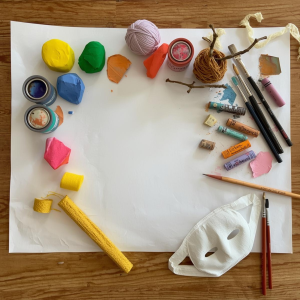 Artistic work can take many forms. Different materials and working methods have different qualities, and these can be used intentionally when designing the work. Painting with paints is fluid and flowing, which can be helpful in gaining more mobility for someone who feels stuck or depressed—first physically, and then also in their thinking.
Working with modelling clay or natural clay requires a different kind of strength and will: shaping, pressing, and forming.
Using voice can be a very powerful exercise, especially for someone who feels they “cannot make their voice heard” in everyday life. Character and stage work offer the opportunity to step into a role and act from that role, exploring and perhaps doing things differently than one’s everyday self would.
I always choose materials according to the needs of the group. If participants are especially open to immersing themselves in the process, exercises can be taken further than in a group with a more cautious atmosphere. Maintaining a sense of safety is always the top priority, so that everyone can work in a way that truly serves their own needs.
Creating an Image
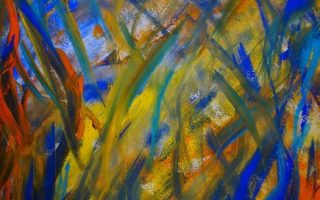
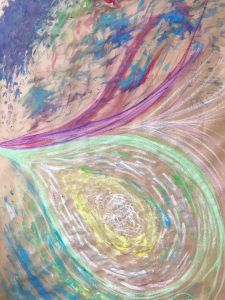 Almost always, during the first session, I guide the image-making process from the very beginning. First, I invite participants to explore the paper with their hands, allowing their hands to move across its surface. This helps presence and surrender to the process, as there is no need to think about whether one is doing it “right” or what it “looks like.”
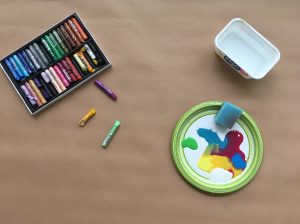
Next, I guide them to take crayons and continue the movement on the surface of the paper. Marks begin to appear—traces of movement—which also become the first elements of the image. Most participants surrender to the process; some prefer to work with their eyes closed so they do not begin to visually analyze what the paper/image looks like or what should be done.
Then I instruct them to take paint and continue the movement on the image surface, and I let them know how much time there is left for creating the image.
I usually do not provide paintbrushes. Instead, participants paint with their hands, a piece of fabric, or a sponge. The intention is not necessarily to create anything representational or detailed. Especially in the first session, it is helpful simply to surrender to bodily movement and allow it to take shape on the paper through crayons and paint.
I have often received feedback from participants that it was important to be able to paint with fingers and leave one’s own hand prints and fingerprints on the paper. Especially today, when we no longer use our hands as much for shaping things—typing on computers, playing colouring or puzzle games digitally—we engage less in the natural human tendency to physically shape and form.
I guide the working process by announcing the remaining time at intervals of 10–15 minutes and more frequently toward the end, so participants can immerse themselves without needing to worry about time. I also actively observe the group during the process.
Occasionally, someone may experience a strong, visible emotional reaction. In those moments, I may move closer to see whether the participant wishes for physical support. Sometimes they do; sometimes they clearly want to be left in peace. Both options are completely okay.
Toward the End of the Art Process
 As the working time draws to a close, I gently guide participants toward finishing the image. The image does not always need to be fully “complete,” but it will reach a point where the process can continue in another form during the next phase.
After image-making, especially in the first session, I usually guide participants into writing. This, too, can be done in many ways; most often I use stream-of-consciousness writing. Participants are first given a moment to let their gaze wander over surface of the image —exploring and wondering rather than analyzing— and then they begin to write whatever words emerge onto the paper.
In this way, we move naturally and fluidly from one art form to another.
After writing, I may ask participants to select a few words and form them into a short poem or condensed expression, which also helps bring the process toward a close.
In later sessions, the artistic work might involve movement, voice, verbal expression, or other forms. There are many art forms.
Closing the Session
 After the artistic work is completed, we gather again in a circle around the central arrangement. Each participant has the opportunity, if they wish, to share something about their process—what they became aware of, what they noticed, and what they realized.
By observing one’s emotional and bodily state, one might notice, for example, that although they arrived feeling tired or in a low mood, they now feel much lighter as the session ends. Other group members (and I) listen and offer space and an experience of being accepted. Each person’s experience is unique, so there is no “right” or “wrong” experience—every experience is valuable as it is.
If time allows, the group may briefly exchange thoughts and experiences in open discussion before we close the session and put away the materials.
Some participants want to take their artworks home; others prefer to leave them at the workspace. Sometimes there is a need to work on a piece—or part of it—between sessions, or simply to spend time with it. Also it depends on the working space, not every space has storage possibility.
At the end of the group or course, the works are usually taken home, and each person does with them as they wish. Some keep them for years, some frame a piece and hang it on the wall, and some want to burn all or part of the works connected to their process.
Everything is possible.